HSNO Substance Approvals
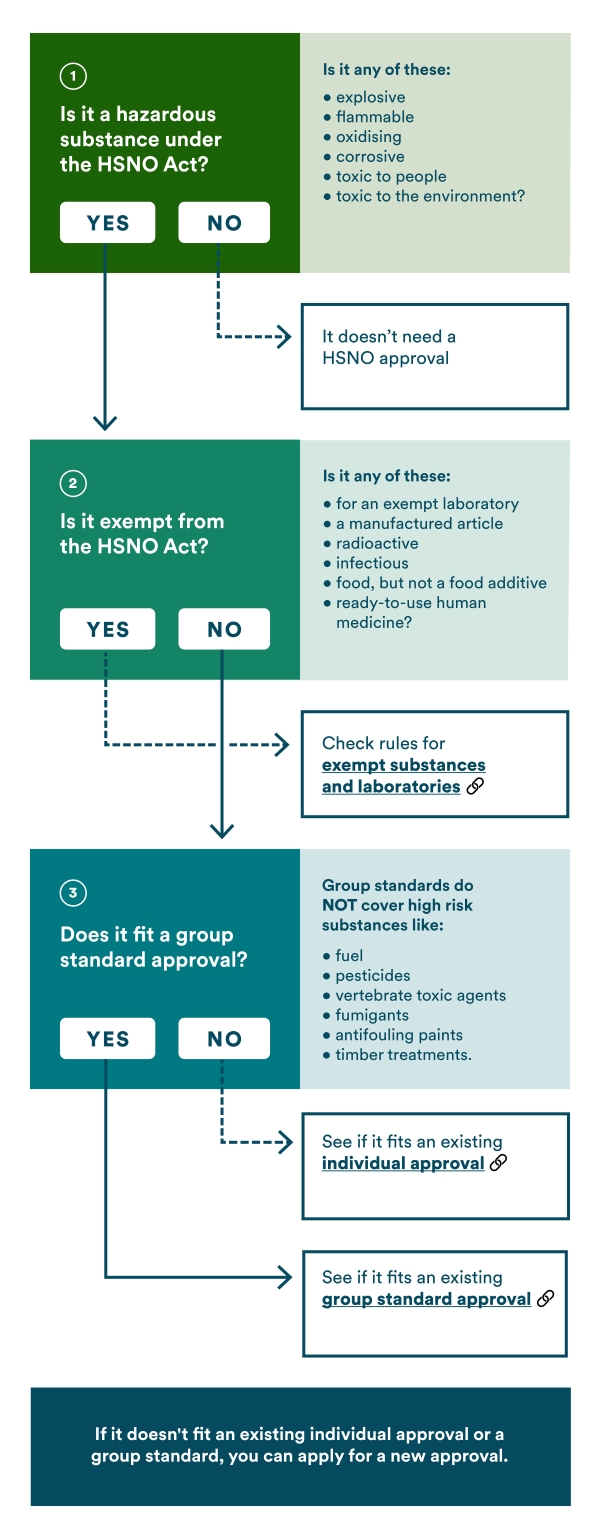
All hazardous substances in Aotearoa New Zealand need an approval.
What are approvals?
An approval is a permission to import or manufacture a hazardous substance for use in New Zealand.
Under the Hazardous Substances and New Organisms Act 1996 (the HSNO Act), all hazardous substances must have an approval from the EPA. The approval sets the rules needed to protect people and the environment. These rules are known as controls.
If the product has no hazards, it is considered to be non-hazardous and doesn't need a HSNO approval.
There are two types of approvals:
- Group standards
- Individual approvals
A hazardous substance is already approved if it matches an existing group standard or individual approval. Most products are approved under group standards.
The flowchart to the right shows how to find the right approval for your product
Substances that need HSNO approvals
Substances and products covered by the HSNO Act are one or more of the following:
- explosive
- flammable
- oxidising
- corrosive
- toxic to people
- toxic to the environment
The HSNO Act also covers substances which, when come into contact with air or water at normal temperature or pressure create a substance with these properties.
Some examples of the types of hazardous products and substances covered by the HSNO Act are:
- agrichemicals
- cosmetics
- explosives and fireworks
- household cleaners
- industrial chemicals
- petrol
- solvents
Substances that don't need HSNO approvals
The Act excludes or exempts some products and substances. You do not need an EPA-issued approval to manufacture or import these. But you might still have to follow rules from other organisations. The substances that don't need HSNO approvals are:
- substances only being used in an 'exempt laboratory'
- a manufactured article such as fabric, paper, leather, machinery or batteries
- radioactive material
- infectious substances, such as septic tank waste
- food - although food additives may need a HSNO approval
- ready-to-use human medicine
Types of approvals
There are two types of approvals under the HSNO Act - group standards and individual approvals.
Group standards for most substances
Most hazardous products and substances used at home or at work are covered by group standards.
A group standard has rules and guidelines that apply to categories (groups) of hazardous substances instead of dealing with each one separately. Examples include:
- aerosols
- cleaning products
- cosmetics
- fertilisers
- food additives
- tattoo inks
Individual approvals for high-risk substances
Some substances are higher risk and need individual attention. These are not approved under group standards – they have individual approvals. Substances that require individual approval include:
- fuel
- explosives
- pesticides
- vertebrate toxic agents such as bait used to kill possums or rats
- fumigants
- antifouling paint
- timber treatments
Release approvals
Most individual approvals are known as release approvals. The approval is given to a substance which can be used anywhere in New Zealand.
Containment approvals
A containment approval is a second type of individual approval. However, it is only relevant to hazardous substances used in research and field trials (in a contained location). It is not issued for the substance, but to the approval holder.
You cannot assign a product to a containment approval. You need to make a specific application.
How to find existing approvals
A hazardous substance is already approved if it matches an existing group standard or individual approval.
In this case, you will need to 'match' a product's use and hazard classification to the existing approval, and 'assign' the product to the existing approval number.
Unfortunately, there is no single place where you can find all approvals.
You can read about how to find existing approvals on the EPA website.
Group standards are approvals for a group of hazardous substances of a similar nature, type, hazard or use. They can give an approval for either formulated products or individual (single-component) chemicals.
Most products will be covered by a group standard.
We've also developed a tool to help you find your approval number if your product is from an existing group standard in one of the general categories from our industry.
Find group standard approvals
The current group standard approvals incorporate the new classification system based on GHS 7, implemented in New Zealand in May 2021. These are the most current versions of group standards - you should be complying with these requirements.
If a product has been assigned to a group standard, the name and HSNO approval number of the group standard should be listed in section 15 of its safety data sheet.
What assignment means
When you 'assign' your product to a group standard you are formally identifying that a substance falls under the rules of that standard. The requirements in the group standard are the rules everyone must comply with.
Fit with scope
For a product to be approved under a group standard, it must fit within the scope of the group standard. It needs to:
- have the physical form specified
- be used for the stated purpose and meet the relevant definitions
- comply with any use restrictions
- have only the allowed hazardous properties
- be listed on the NZIoC if it is a hazardous single chemical
The scope of each group standard lists specific hazard classifications that the product must have in order to be assigned to that group standard. It also lists certain hazard classifications that the product may or may not have.
Keep a record of assignment
Once a product has been assigned to a group standard, you must keep a record of the self-classification and assignment.
The record must contain enough information for an enforcement officer or someone else to verify the product classification and group standard assignment.
You don't need to notify the EPA when you have assigned a product to a group standard and completed the record. You also don't need to send them a copy of the record.
Getting Help
If you're still not sure whether you need to have an approval for a substance or product there are people who can help.
For a fee, the EPA can tell you whether a product or substance is hazardous, already approved under the HSNO Act or what its hazard classification is.
You can also find a consultant to support you with this.
Useful links
Exempt substances and laboratories - Learn more about what kind of substances and laboratories are exempt, and the rules to follow in these cases.
Group standards - See if your product fits under a group standard, and what to do if it does.
Individual approvals - See if your product fits under an existing individual approval, and what to do if it does.