#35 - Thermoplastic Coatings vs Thermoset Coatings

In the Automotive Refinish Industry we use many different types of paints depending on the job at hand, however most of the coatings we use fall into two main groups: Thermoplastic or Thermoset.
Note: most common plastics can also be described as either being Thermoplastic or Thermoset, so one way to look at the paint coatings we use is they're a "liquified form of plastic" after the curing process the paint dries to a plastic film.
What's the difference?
Thermoplastic Coatings:
- Even when fully cured thermoplastic coatings remain both solvent and heat sensitive, meaning they will soften under hot conditions and will melt back to a liquid state when coming in direct contact with solvents.
- They are generally easy to apply.
- More flexible and impact resistant.
- Cure with linear molecular chains (a weak structure, flows with heat).
- They are generally 1K products that cure by solvent evaporation.
- Examples, 1K primers, 1K clearcoats, alkyd enamels, acrylic lacquer, both solvent and waterborne basecoats etc.
Thermoset Coatings:
- When fully cured thermoset coatings are both heat and solvent resistant meaning they will not turn back into a liquid state.
- During the curing process thermosets undergo a chemical crosslinking reaction (with the added catalyst) forming a hard, heat and solvent resistant permanent finish.
- They have a strong structure - a network of crossed molecular chains (between resin and catalyst).
- Provide outstanding all-round durability.
- Examples: 2K primers, 2K polyurethane colours, 2K clearcoats, etc.
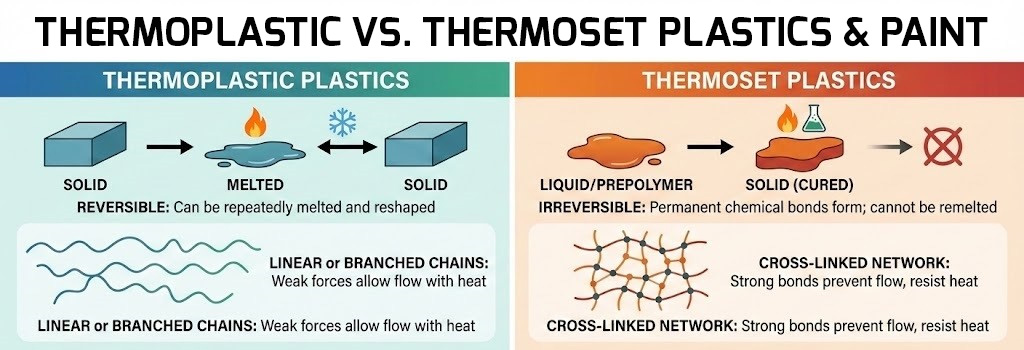
Image: MCM Composites USA
Contact your local DeBeer Representative for more information.

This tip was originally written for DBNZ Coatings and has been re-posted with permission.
Download Tech Tip #35Size: 294.73 KB | File Format: .pdf